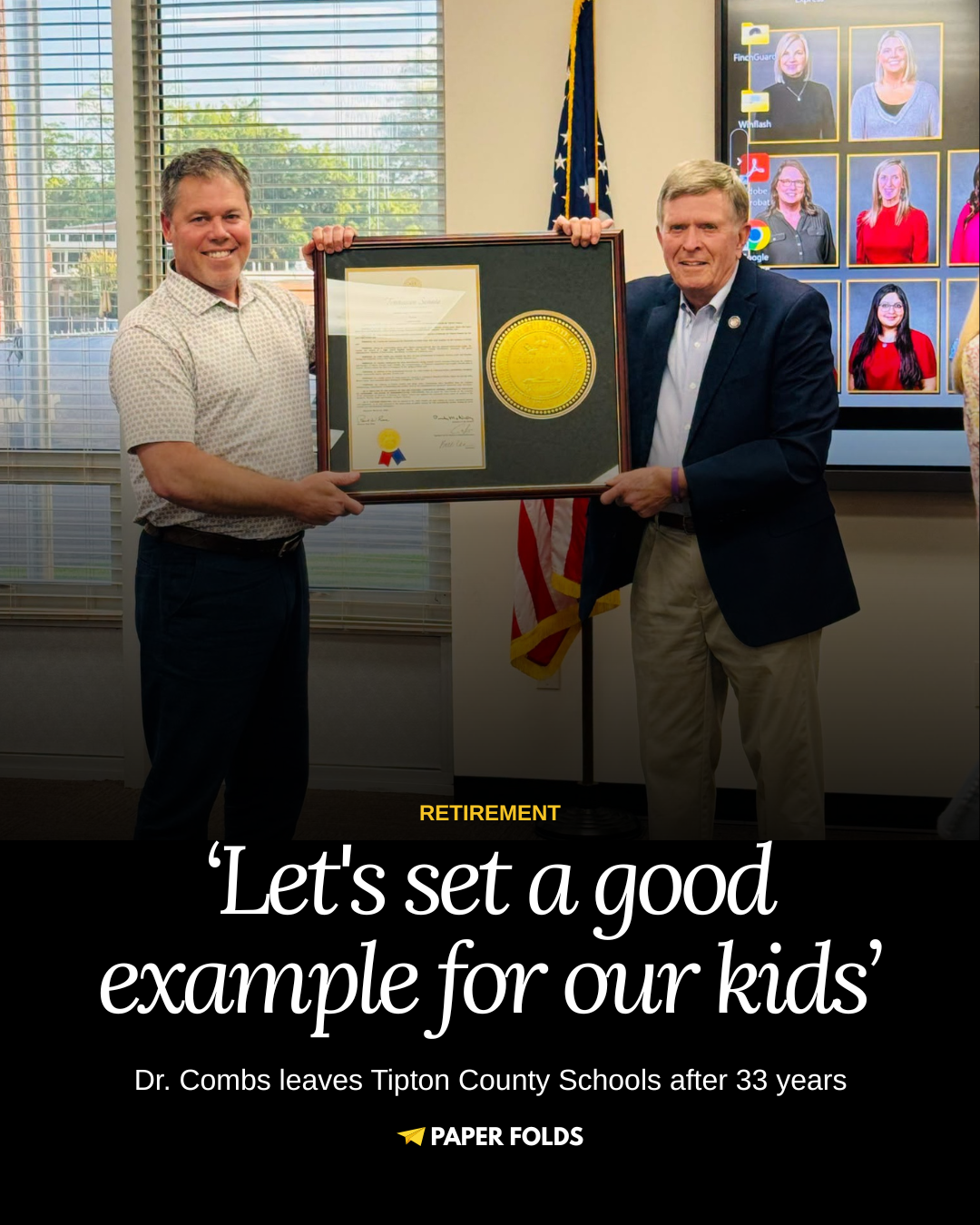

The day after the tornadoes hit in 2023, when Covington was still sorting through what it had lost, Dr. John Combs got on the phone with parents.
Two schools were gone. A section of town was damaged. Someone had died. He told parents he’d work with them, that attendance during recovery wasn’t something anyone needed to stress over, that they should make the best decisions for their families. Then he added two more words.
“Love y’all.”
One parent posted that it was the most moving message she’d ever received from a public official.
In one of the hardest moments Tipton County had seen in years, he knew what people needed to hear. It’s one of the defining moments of a 33-year career he’s saying goodbye to this week, a career that asked more of him than it asked of any superintendent before him.

His early career
Combs came to Tipton County in 1993 from outside St. Louis. He was a ninth and tenth grade English teacher at Munford High School who coached football, baseball, and wrestling on the side. He had no particular reason to stay, but when Brighton High School opened in 1996, he raised his hand to help start it.
“When Brighton High School opened in 1996, they basically pulled teachers from Covington High and Munford High,” he said. “I went to Brighton High School and taught tenth grade English. And assistant baseball coach under the leadership of Mr. Grant Shipley, who was a great principal, by the way.”
He stayed at Brighton through 2002, took over as principal of Brighton Middle for a decade, then spent seven years as assistant superintendent under Dr. Buddy Bibb.
“Dr. Bibb was great. I mean, great. He did a lot of focus on policy and that kind of thing. He was a great leader. He and I have a different style of leadership, but kind of as one of his two assistant superintendents, I got to see a lot that went on in the room.”
He said he sat in on hard conversations and kept meticulous notes on every unusual situation that crossed his desk.
“Working so closely with him, I had seen a lot — a lot of conversations with the attorneys, a lot of investigations, a lot of sitting in meetings and taking minutes and having to make decisions in his absence. We even used to call them the X-Files. I kept them in my office.”
In 2017, after nearly a quarter-century working his way through every level of the system, Combs became superintendent.
“I thought I was ready,” he said.
He had no idea what was coming.

The man behind Mr. Bean
If there’s one thing you know about Dr. Combs, it’s that he enjoys a fun snow day post.
When inclement weather hits, he and several other people are working to determine what’s safest for the people in Tipton County.
He’s been out at 2 a.m. driving the roads, texting with Sheriff Shannon Beasley and Emergency Management Director Baker McCool, watching weather updates roll in from the National Weather Service, collecting reports from a team stationed across the county. Then he’d make the call and post it with a meme.
“Bean or Bigfoot, one of the two,” he said, laughing. “I’m trying to make it fun for kids. That’s the whole point.”
If there’s another thing you know about him, it’s that parents often disagree with the decision to close schools and openly criticize him. While it’s easy to make posts on social media discussing the decision you’d make if you were Dr. Combs, there’s a lot more responsibility involved when you actually are.
“First couple years I’d let it eat at me. Like, ‘No, y’all don’t understand … it’s these roads, they’re still bad! I’ve been there, I was just there 30 minutes ago, I know what that road looks like …’ But after a while you’re just like … I’m responsible for 10,000 kids and 1,500 employees.”

Facing unprecedented challenges
Each superintendent has had his own set of difficulties. Combs’ tenure brought challenges no predecessor faced: a global pandemic, protesters on both sides of the mask debate, a statewide curriculum law that threatened districts with fines of up to $1 million, and a tornado that leveled two schools in a single night.
COVID hit first, and hit without warning.
“I wasn’t prepared for a whole lot of that,” he said. “We were building the ship as you’re sailing it. I don’t think anyone was [prepared].”
The district had to cancel in-person instruction and activities with two months left in the 2019-20 school year, reformat graduations, and move to one-to-one student devices on the fly in a county where some families, and some teachers, didn’t have reliable internet at home.
And then there were the quarantines, social distancing, and the mask mandates. This was an especially contentious time, a period in which tempers flared both in favor of and against the requirements.

Combs never imagined he’d see a day where there were protests outside his office window.
“One day they’re picketing because they don’t want to wear masks, and the next day another group’s picketing because they do want to wear masks,” he said.
During one school board meeting, parents protested outside the central office and banged on the windows during proceedings.
The political pressure didn’t end with COVID. Instead, it found a new target in the fight against Critical Race Theory, an academic framework developed in law schools that examines racial bias. It became a war over curriculum whose target became Combs.
Tennessee passed a law in May 2021 banning the teaching of concepts lawmakers labeled as critical race theory in K-12 public schools. Gov. Bill Lee signed it, and it took effect July 1, 2021.
“Which, by the way, no legislator could define,” he said. “We’d ask them all. I was in a meeting with all other superintendents in Nashville at the microphone with them on the stage and said, ‘Can somebody tell me what this means?’ No — crickets. It wasn’t even an ‘I gotcha’ thing. It was like, no, tell us — if you want us to do this, explain to us what it is and what it means. Because everyone, even those that didn’t like my decisions, I don’t think any of us agreed on what it meant. Even if you read the legislation on it, it’s not incredibly clear.”
Then, on March 31, 2023, came the biggest test of his career.
The weather looked bad that afternoon. Combs checked with Beasley and McCool, watched the data, and dismissed students at 1:30 p.m. Some parents were frustrated by the early release.
Early that evening, tornadoes tore through Covington. Crestview Middle and Crestview Elementary were destroyed by 6 p.m., the same time School-Aged Childcare would have regularly closed. A softball game was scheduled that afternoon at Crestview Middle.
Combs drove to the schools once it was safe. Standing in front of the wreckage, the weight of the decision he’d made hours earlier hit him for the first time.
“It wasn’t real to me what could happen, if I hadn’t [closed schools early],” he said. “Not everyone gets to experience, as a leader, the result of a decision like that. That was a little exclamation point: No, John, don’t listen to the noise. Use your input from the specialists. Make an informed decision.”
The complaints about weather closures dropped off after that night.

His legacy
Ask Combs about his legacy and he doesn’t point to the new buildings.
“I guess the answer a lot of people would expect would be the new schools,” he said. “But I don’t think that’s it.”
What he names first is Career and Technical Education — restoring the technical and dual paths that disappeared when the state moved every student onto a single ACT-exit track, and hiring a district-level specialist to connect students to TCAT programs, jobs and scholarships.
“Let’s take someone with a four-year philosophy degree, a job and a bunch of debt,” he said. “Let’s take someone who’s a lineman in Memphis with zero debt because they went through as a journeyman, making twice as much. You’ve got to help them get to where they want to be. Pick a path.”
Second is the endurance of employees.
The second thing I’m most proud of is our teachers and our faculty members being able to endure through the myriad of legislative changes the last eight years, being able to endure and try to keep doing what’s right for kids. I think those are my two biggest things.”

What he leaves behind
At his last principals’ meeting a few weeks ago, Combs closed with a story he picked carefully for the occasion: Two people sit at a table, each with a glass. One looks into the other’s glass to see if they have more. The other looks across to see if the first person has enough.
“Some people live their whole life comparing what they have to everybody else,” he said. “But imagine if everybody lived their life asking whether the person across from them has enough. That’s how you lead. That’s how you teach kids. I certainly failed miserably at that a lot. But that is always what I strive to do.”
He’s not sure what retirement looks like yet.
“I’ve had a lot of offers to do things, but I just don’t want to do anything full-time. I’m kind of out of that phase. I want to be disconnected when I can from that phone.”
His son has already given him orders, though.
“My son has already told me, ‘Dad, join the gym!’ He said, ‘Don’t lay in bed. You need to get up when Mom goes to work. Get up and go to the gym.’ He’s a smart fella. So I did. I went ahead and joined the gym.”

He’s especially looking forward to spending time with the newest member of the family.
“I’m going to play with my grandkid a lot,” Combs said with a proud smile. “Get caught up on some stuff – my wife has already started generating the list for at the house.”
He’s also looking forward to something he participates in every year.
“They’ve already invited me to Ditch Day. Ditch Day is a big weed-eating day where all the maintenance folks converge on that huge ditch over around Brighton High School. A lot of times I’ve jumped in that with them, and we’ve done that together. I’m ready to do it because I can, not because I have to. If this county needs me to help with stuff, I’m going to be here to help.”

When Combs left the building this week, he left behind a legacy like no other.
And he’s ready to leave it all behind.
Ask what he’ll miss most and he doesn’t hesitate.
“The people,” he said. “Including the kids.”
He used to be afraid of small children, but they’re one of his favorite parts of the job.
And graduation, always graduation.
“Seeing those faces walk across the stage — it’s so neat,” he said. “I’m gonna miss that interaction.”
His parting words came without a pause: Don’t take the youth in our county for granted.
“Our youth are going to be molded not just by the education system. Let’s help them find jobs. Let’s encourage them. Let’s set a good example for them. Let’s help guide them in a way that’s going to be good for them and good for this community and good for the country, because they’re always watching. They’re little video recorders on legs. They’re watching everything we do. They know when we lie. They can smell fear. They know when our elected officials say one thing and do another. They know when their superintendent says one thing and does something else. Let’s set a good example for our kids.”