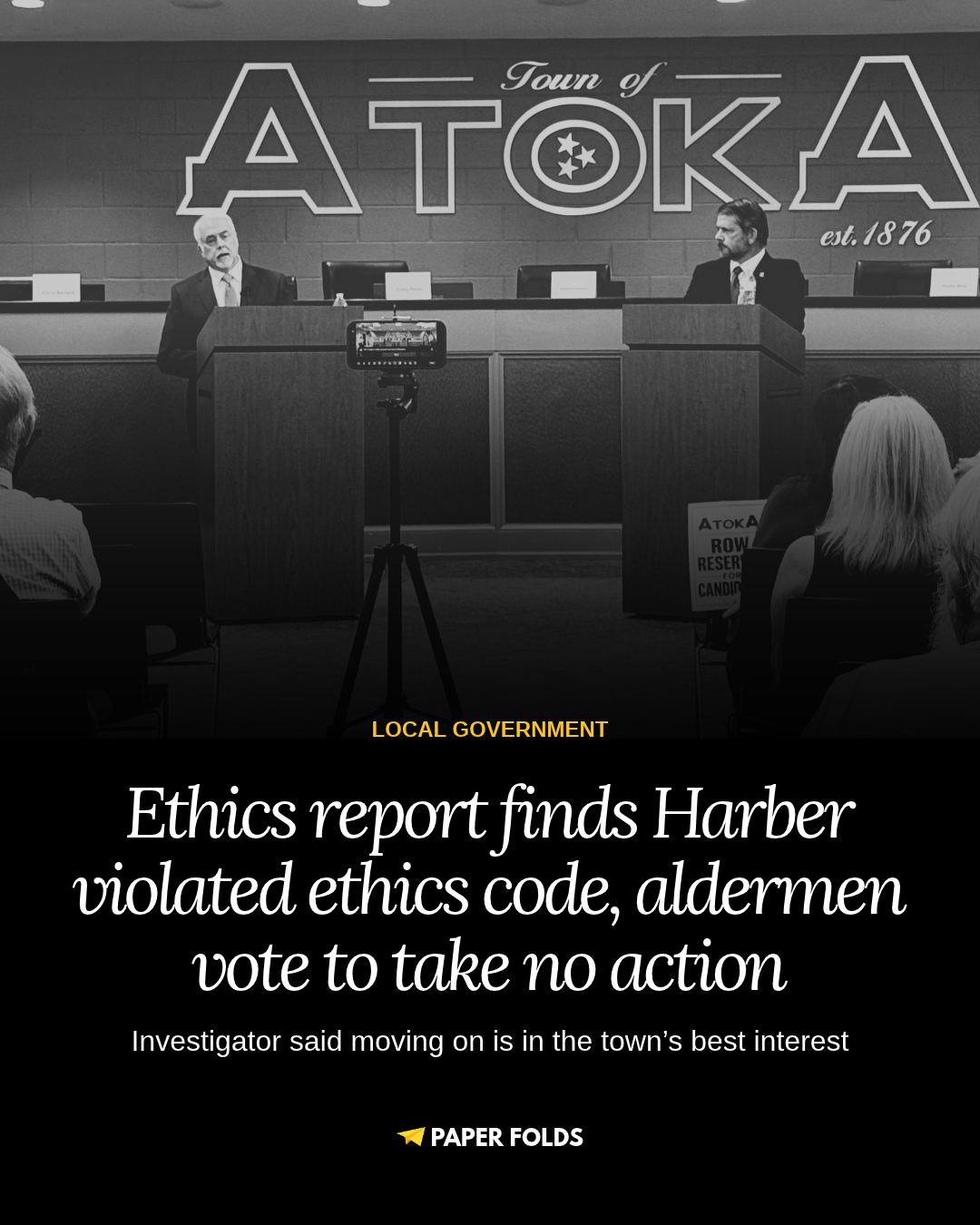
An outside investigator found that outgoing Atoka Vice Mayor John Harber violated the town’s ethics code when he asked the fire chief to have his wife remove a Facebook reaction to a post critical of him during the mayoral race. Aldermen voted Monday night to take no action on the report.
Investigator Rachel Simmons found no ethics violations in the other three complaints she reviewed, including Harber’s complaint against Mayor Barry Akin over public comment time and his claim that the Oct. 8 board meeting was a coordinated attack on him.
The board also voted to waive attorney-client privilege on the report’s exhibits and post the full report, more than 30 pages plus more than 200 pages of exhibits, on the town’s website.
Simmons’ role was advisory, and the board was not bound by her findings. Alderman Brett Giannini, who made the motion to take no action, called the findings against Harber and Akin “mistakes in judgment.”
“We’re looking at someone asked someone to remove a like off of Facebook,” Giannini said. “And then the other one is he forgot that we had a 2-minute, 2 minutes in the resolution.”
Alderman Chris Detje voted against it.
“We can’t pick the rules that we enforce and we follow,” Detje said. “It’s either all of them or none of them.”
What the investigator found
Town Attorney Amber Shaw summarized the report, which Simmons completed Nov. 20, and read portions of it aloud. Shaw stressed that the review was limited to the town’s ethics code and charter. It made no findings on First Amendment claims or alleged criminal conduct, and there is no criminal investigation or civil lawsuit.
Participation was voluntary. Simmons sent written questions to Harber through his attorney, David Pickler, on Nov. 17. According to the report, neither Harber nor his attorney responded.
Complaints 1 and 2: Harber’s Facebook requests. Simmons reviewed Detje’s Oct. 9 request and Krista Scott’s written complaint together because they overlapped. Scott, who is married to Fire Chief Bill Scott, said Harber asked the chief in a late-night June 12 message to have her remove her reaction to a Facebook post critical of him. Detje confirmed to Simmons that Harber had also texted him asking him to remove his support.
At the Oct. 8 meeting, Harber said his request “was not a demand” and that he had asked employees to remain neutral. Simmons wrote that no message she reviewed said anything like that, and every witness she asked said they had received nothing similar.
Simmons also spoke with Atoka resident Sandy Styer, who said that after she commented on one of Harber’s Facebook posts during the campaign to contradict it, Harber called her husband, Brian Styer, rather than her. Brian is a Tipton County CERT team leader, post chaplain and service officer for Tipton County American Legion Post 67, and an assistant chaplain for the Tipton County Veterans Council. He reportedly declined to ask her to remove the comment, and Sandy described the call as voter intimidation. Simmons wrote that Sandy’s account was outside the five complaints and uncorroborated, and she based no findings on it. She included it because it describes the same pattern.
She found Harber violated Ethics Code Section 1-408(2), which bars officials from using their position to secure a privilege not authorized by the charter, law, ordinance or town policy.
“Put plainly, the privilege Alderman Harbor sought was to limit criticism of himself and to improve his chances in the election,” Simmons wrote.
Scott, whose complaint was among those Simmons upheld, told Paper Folds News she was pleased with the review.
“I appreciate the thorough investigation the special attorney did looking into this ethics violation,” Scott said.
Simmons also examined Harber’s seven Facebook messages the night before the Oct. 8 meeting to Brook Taylor, a newly appointed Industrial Development Board member he had never met. The messages included screenshots of offensive posts by IDB consultant Terry Roland. Simmons wrote that several of Harber’s statements in those messages were incomplete, including that Roland’s $40,000 contract was awarded with no other bidders. She found the IDB had approached two other consultants, and both declined.
Under a narrow reading of Charter Section 12, which limits what an individual alderman may do, Simmons found no charter violation, because IDB members are not town officers or employees. She applied that narrow reading but wrote that under a broader reading, Harber “plainly violated” Section 12 by trying to influence an independent board’s business.
A Section 12 violation carries forfeiture of office. Simmons called that question moot because Harber’s term ends when the new board is sworn in next month.
“It is in the best interest of everyone, especially the town, to move on,” she wrote.
Complaint 3: Akin’s public comment extension. Harber filed this complaint Oct. 10 after Akin allowed speakers three minutes instead of two at the Oct. 8 meeting. Simmons found Akin did not have the authority to do that on his own. The resolution allows extra time only when a speaker asks.
She found Akin acted in good faith but was “careless” not to review the resolution first, and that the extension contributed to the public perception that the meeting was a coordinated attack on Harber. She found no evidence he did it to benefit himself or knew who would speak. Because Akin publicly admitted the error and put a new resolution before the board, she found no further action warranted.
“I do not know what more he could have done to remedy the error, which he publicly admitted,” Simmons wrote.
Complaint 4: The Oct. 8 meeting. Harber also asked whether the meeting was “contrived to discredit a local candidate,” citing an email from Tipton County Commissioner Jason Skinner. Simmons found no evidence of coordination. Every person she asked said no one asked them to speak. Three of the six speakers did not address Harber at all, and two of the three who did finished within 15 seconds of the two-minute limit.
“If Mayor Akin’s stated reasons were pretext and there was coordination, the speakers didn’t get the memo,” Simmons wrote. She found the comments about Harber were “an organic response to his own statements and conduct.”
Complaint 5: The Kroger call. Planning Commission Chairman Stephen Shopher alleged Harber called him before a January 2024 vote on the Kroger expansion and told him to urge every commissioner to approve it. Taking that account as true, Simmons found no violation of the ethics code or charter, since no one alleged Harber had a financial interest in the project. Any Open Meetings Act question falls outside the investigation, she wrote. She made no findings on a second allegation that Harber and other aldermen discussed board business after meetings and referred it to Shaw.
How the board voted
Alderman Chris Schaeffer was absent.
Waive privilege on exhibits: Passed 4-0. Giannini made the motion and Detje seconded. Harber abstained on Shaw’s recommendation.
Post the report online: Passed on a voice vote. Giannini made the motion and Alderman Jeremy Lightsey seconded. Harber abstained.
Take no action: Passed 4-1. Giannini made the motion and Lightsey seconded. Poole, Giannini, Harber and Lightsey voted yes, and Detje voted no. Harber, who had abstained on the first two votes, voted yes.
Accept the report’s “move on” finding: Passed 4-1. Alderman Jessie Poole moved to accept the passage Shaw read stating that forfeiture was moot and the town should move on. Poole, Giannini, Harber and Lightsey voted yes, and Detje voted no.
Before that vote, Shaw told the board it could not remove an elected official by resolution. Simmons’ report states that forfeiture is not accomplished by a vote of the board and that removal for misconduct requires a court ouster proceeding.
“The town does take seriously any allegations put forth by the citizens,” Akin said. “I hope that you realize it was a very thorough and detailed findings.”
Recommendations for the future
Simmons also made three policy recommendations that do not depend on her findings. The board did not act on them Monday.
She recommended a social media policy for elected officials that does not restrict their right to speak as private citizens; ethics, open meetings and public records training for the whole board after every election; and a code change to defer ethics investigations involving candidates within 60 days of a town election, with exceptions for urgent risks to the town.
“Ethics investigations don’t have a place in politics,” Shaw had told the board Oct. 13, a remark Simmons cited in support of the third recommendation.
How it got here
Scott and Taylor raised their claims during public comment Oct. 8. Detje submitted a written request for an investigation the next day, and the board hired Simmons, Covington’s city attorney, on Oct. 13. The report was originally expected Nov. 10 but was delayed so Harber could respond.
Akin defeated Harber in the Nov. 3 mayoral election. Harber did not seek re-election as alderman. No one signed up to speak during public comment Monday.
What’s next
The full report and exhibits will be posted on the town’s website, atokatn.gov. Akin said staff expected to have it online within an hour of the meeting.
The new board will be sworn in at the December meeting. A resolution to raise the public comment limit to three minutes returns to the board Dec. 8.