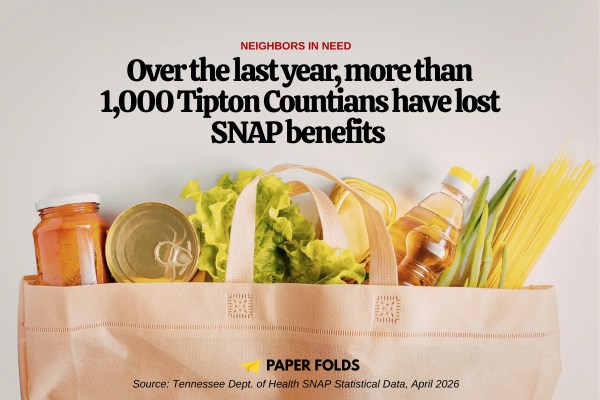


A year ago, 1 in 10 Tipton Countians received help buying groceries. Today, it is 1 in 12.
That shift represents 1,058 people who lost access to the Supplemental Nutrition Assistance Program between April 2025 and April 2026, according to official monthly reports from the Tennessee Department of Human Services reviewed by Paper Folds News.
SNAP, the program most people still call food stamps, helps low-income individuals and families buy groceries through a monthly benefit loaded onto an electronic benefits card.
Those 1,058 people came from 373 households. Each one lost about $191 a month in grocery assistance, roughly $6 a day.
Every day, $6,734 in food assistance no longer reaches Tipton County families who had it a year ago. Over a full year, that is roughly $2.4 million in grocery money that is simply gone.
How it happened
The losses did not arrive all at once.
By September 2025, Tipton County’s enrollment had already slipped to 6,324, down from 6,366 the previous April. Then Congress failed to pass a budget, SNAP benefits froze temporarily across the country, and enrollment dipped further. Benefits came back in November – the numbers briefly climbed to 6,492 – but the recovery did not hold.
The bigger force was federal legislation. In July 2025, President Donald Trump signed the One Big Beautiful Bill into law, enacting the largest cuts to SNAP in the program’s history, an estimated $186 billion through 2034, according to the Congressional Budget Office.
The law changed who qualifies. In Tennessee, able-bodied adults without dependents had been required to work, volunteer, or attend job training up to age 54. The new law raised that ceiling to 64.
It changed things for parents, too. Previously, a parent or caregiver of a child younger than 16 was exempt from the work requirement. Now, that exemption only covers children younger than 14. Parents of teenagers as young as 14 must now meet the work requirement to keep their benefits.
Those rules took full effect Feb. 1, 2026. Tipton County’s enrollment fell to 5,308 by April, the lowest point in the data reviewed.
Who is feeling it most
The data point to families.
The number of Tipton County households receiving benefits dropped 12.2 percent. The number of individual recipients dropped 16.6 percent. When individuals fall faster than households, it typically means larger families, not single adults, are the ones being cut off. That tracks with the new rules targeting parents of older children.
Why the timing matters
Losing food assistance is hard at any point. Losing it right now is something else.
Grocery prices in April 2026 were 2.9 percent higher than they were a year earlier, according to the USDA’s Economic Research Service. Families who lost SNAP benefits are now stretching further at a more expensive grocery store with less help than before.
Gas makes it worse. According to AAA, Tennessee drivers are now paying an average of $4.16 per gallon – up from $2.76 a year ago – a jump of roughly 50 percent in 12 months.
For lower-income households, that is not a minor inconvenience.
Research from the Federal Reserve Bank of New York released in May 2026 found that households earning below $30,000 spend roughly 7.1 percent of their income on fuel, more than twice the rate of higher-income families.
Every trip to a grocery store costs more. Every errand costs more. For families already making hard choices, losing food assistance on top of all of that is not an abstract policy outcome. It is a decision between bills.
Tipton County is not alone
Statewide, more than 100,000 Tennesseans lost SNAP access over the same period – a 14.6 percent decline, according to the TDHS. Tipton County’s drop of 16.6 percent is steeper than the state average.
While SNAP purchases are exempt from sales tax, they support local grocers whose employees and operations contribute to the broader local economy. The USDA estimates that every $1 in SNAP benefits generates approximately $1.50 in economic activity.
Across Tennessee, food banks have reported sharply rising demand as families look for other ways to cover what benefits no longer provide.
Food Assistance in Tipton County
There are food disbursements taking place all over the county nearly every day of the week.
For information on food assistance resources in Tipton County, visit paperfoldsnews.com/food-assistance-in-tipton-county.